Contractor reviewing paperwork on-site while managing chimney estimate follow-up for residential repair work.

Chimney Estimate Follow-Up: The Real Reason Your Chimney Estimates Are Going Quiet

If your chimney estimate follow-up process is inconsistent, jobs will disappear even when the phone is ringing. Most chimney companies do not lose jobs because they are too expensive. They lose jobs because the estimate went out, nobody followed up, and the homeowner hired the first company that stayed in touch.

By May, many owners start blaming the slow season. In a lot of cases, the problem showed up after the estimate.

Why This Happens in Chimney During May

May creates a strange gap for chimney companies.

The emergency calls from heat season are gone. Homeowners are thinking about vacations, outdoor projects, and summer plans. A Level 2 inspection or flue liner project is rarely at the top of their list.

That means estimates sit longer.

A job that might have closed in 24 hours during January can take a week or more in May.

The companies that consistently close the job are usually the ones that stay in contact after the estimate.

We regularly see ServiceTitan accounts with dozens of open estimates older than 14 days. Nobody called. Nobody texted. Nobody checked back in.

The owner assumes demand slowed down.

The estimate simply went quiet.

How to Tell If Your Chimney Estimate Follow-Up Is Seasonal or Structural

Look at your numbers from the last 30 to 60 days.

If calls are down, that may be seasonal.

If calls are steady but estimates are not closing, that points somewhere else.

A few signs that your chimney estimate follow-up process is breaking down:

  • Estimates sit untouched for more than 48 hours after being sent.
  • Homeowners stop responding after the initial visit.
  • Crews have open days on the schedule despite steady estimate volume.
  • You hear “we decided to wait” more often than usual.
  • Technicians are generating quotes, but booked jobs are not increasing.

Many owners focus on generating more calls when the jobs they already quoted have not been worked properly.

The math speaks for itself.

What Most Chimney Owners Get Wrong About This

Most owners believe the estimate itself does all the work.

It doesn’t.

Homeowners often request multiple estimates for chimney rebuilds, masonry repairs, crown repairs, or liner replacements. The company that follows up professionally often gets another chance to answer questions and address concerns.

That is especially true when homeowners are comparing prices.

Price shoppers exist, but many lost jobs have nothing to do with price.

A homeowner who receives three estimates and hears back from only one company often hires that company.

This is one reason we recommend owners periodically review their process through a Marketing Review instead of focusing only on advertising performance.

What Actually Matters Instead

The businesses that stay busy through slower periods usually focus on four things:

First, budget clarity. They know exactly how much wasted spend is being tolerated and whether booked jobs justify the monthly investment.

Second, job quality. Better jobs, not more calls. A $6,000 liner replacement is worth more than several low-value inspections that never move forward.

Third, positioning. Homeowners want confidence. Certifications, experience, clear communication, and professional presentation matter. Organizations like the Chimney Safety Institute of America have spent years reinforcing professional standards across the industry.

Fourth, consistency. The follow-up happens every time. Not when someone remembers. Not when the schedule is light. Every time.

Many owners who think they need more advertising actually need a better process after the estimate. The same pattern shows up in businesses discussed in our article on How to Tell If Your Marketing Is Broken or Just Seasonal.

Smartphone displaying unanswered customer messages related to chimney estimate follow-up inside a contractor truck.

What We See Working Inside These Businesses

The companies that close more chimney work in May usually have simple systems: The technician sends the estimate before leaving the driveway, Someone follows up within 24 hours, another follow-up happens several days later, and questions get answered quickly. Speed to lead matters after the estimate, too.

One chimney company had more than $80,000 in open estimates sitting untouched. After implementing a consistent follow-up routine, several jobs closed within weeks without increasing advertising spend.

Another company assumed Google Ads was failing. After reviewing the account and operations, the real issue was estimates that never received a second call. Resources from the Google Ads Help Center can help owners understand ad performance, but ad performance alone does not explain why estimates go cold.

The businesses that stay dialed in understand that marketing gets the phone ringing.

Follow-up gets the job booked.

For owners trying to understand where money is leaking, our Case Studies and Marketing Services pages show real examples of operational issues that affected booked work.

FAQ

Why are my chimney estimates not closing in May?

May is often slower than heat season, but many companies lose jobs because follow-up becomes inconsistent after the estimate is sent.

How long should chimney estimate follow-up continue?

Most estimates deserve multiple follow-up attempts over the first two weeks. Many homeowners delay decisions even when they intend to move forward.

Does a low close rate always mean my pricing is too high?

No. We frequently see estimates that do not close because nobody followed up, not because pricing was the deciding factor.

What should I track in my chimney estimate follow-up process?

Track estimate volume, estimate age, follow-up activity, and booked jobs. Those numbers reveal where jobs are being lost.

Can better advertising fix poor chimney estimate follow-up?

More calls will not solve a broken follow-up process. If estimates are already going quiet, additional calls often create more of the same problem.

If you want another set of eyes on where jobs are being lost, we’re always happy to have a conversation.


Brick chimney on a luxury home during spring representing why chimney companies lose calls in spring during slow season.

Why Chimney Companies Lose Calls in Spring That Have Nothing to Do With Slow Season

Most chimney companies expect call volume to slow down in May. The problem is a lot of owners blame seasonality for issues that are actually costing them booked jobs every day. When spring call volume drops harder than normal, there is usually something broken in the setup long before the slow season starts.

We see this every year in chimney and fireplace companies. The phone gets quieter after heat season ends, but the companies that stay steady through spring are the ones with clean follow-up, fast response times, and better positioning. The companies losing jobs usually have estimates sitting untouched in ServiceTitan, missed calls after hours, or ad spend going toward price shoppers instead of better jobs.

Why Chimney Companies Lose Calls in Spring During May

May exposes weak systems fast.

During peak heat season, a chimney company can survive a sloppy setup because volume hides the problem. Even average follow-up can still produce booked jobs when homeowners are actively worried about smoke issues, creosote buildup, or failed inspections.

Spring is different.

Homeowners stop calling with urgency. Now every missed call matters. Every estimate that sits for three days matters. Every slow response to a Level 2 inspection request matters.

Most chimney companies see call volume drop somewhere between 40 and 60 percent between March and August. That part is normal.

What is not normal is when your booked jobs disappear faster than the seasonal slowdown itself.

That usually points to one of these problems:

  • Calls going unanswered during business hours
  • Slow estimate follow-up
  • Bad Google Ads targeting
  • Weak Google reviews
  • No clear difference between you and the next chimney company
  • Spending money on calls that only want the cheapest sweep possible

A lot of owners think they need more calls. Most of the time they need fewer wasted calls and more jobs that actually close.

You can see this pattern clearly in companies that stay dialed in year-round. Their crews stay busy because they protect the calls they already paid for. Think with Google has published years of homeowner search behavior showing how quickly people move on when they do not get a fast response.

How to Tell If Your Chimney Company Losing Calls in Spring Is Seasonal or Structural

Seasonal slowdown still produces steady activity.

You still get inspection requests.
You still get fireplace repair calls.
You still get relining estimates.
Word of mouth still moves.

Structural problems look different.

The phone suddenly goes quiet even though your rankings stayed stable.
Your estimates stop closing.
You start hearing more price objections.
Crews sit idle randomly instead of predictably.

One chimney company we looked at had solid call volume but was losing over half their estimates because nobody followed up after the first visit. The owner thought the market had dried up. The real issue was that homeowners were getting a second estimate and never hearing back from his office again.

Another company had their Google Ads account pushing outside their actual service area for months. They were paying for calls two hours away that never became booked jobs. Once the targeting got cleaned up, the wasted spend dropped immediately and the better jobs started coming back.

That is why marketing reviews matter more in spring than peak season. Problems become easier to spot when the volume slows down.

What Most Chimney Owners Get Wrong About Chimney Companies Losing Calls in Spring

Most owners focus on traffic.

They look at rankings.
They look at clicks.
They look at how many calls came in.

But the math usually breaks after the call.

The companies that stay stable through spring are usually strong in three areas:

  • Speed to lead
  • Consistent estimate follow-up
  • Clear positioning

A homeowner looking for a chimney inspection in May is often planning ahead for renovations, home sales, insurance work, or preventive maintenance. Those jobs are usually better jobs than emergency winter sweeps.

But they also shop carefully.

If your office takes two days to call back, you lose the job.
If your estimate looks rushed, you lose the job.
If your reviews look stale, you lose the job.

A lot of chimney companies are losing jobs after the estimate without realizing it. That is why How to Tell If Your Marketing Is Broken or Just Seasonal hits so close to home for owners dealing with feast or famine cycles.

Chimney service truck parked outside a suburban home showing how chimney companies lose calls in spring when follow-up breaks down.

What Actually Matters Instead

The companies that hold steady through spring usually have boring systems that work consistently.

Their phones get answered.
Their estimates go out fast.
Their follow-up is predictable.
Their ads stay focused on profitable work.

That matters more than flashy marketing.

One company can spend $6,000 per month and still have crews sitting idle because nobody closes the jobs. Another company spends less but keeps the calendar steady because they nail the follow-up and stay disciplined about the work they actually want.

This is where marketing services for contractors either help the business or quietly hurt it.

If the setup pushes cheap sweep calls nonstop, the owner stays busy but margins stay weak.
If the setup focuses on inspections, rebuilds, relining, and higher-value work, the calendar stays healthier through slow season.

The difference is usually positioning and follow-through, not magic.

The CSIA has been talking for years about homeowner education around inspections and maintenance. The companies that communicate clearly around safety and long-term chimney health usually avoid the race to the bottom on price.

What We See Working Inside These Businesses

The chimney companies that stay consistent in spring usually have one thing in common.

They treat spring like setup season instead of survival season.

They clean up old estimates.
They tighten service areas.
They improve review collection.
They fix broken call handling.
They prepare before fall demand hits again.

That work compounds.

By the time September arrives, the companies that stayed disciplined through spring are already ahead while everyone else is scrambling to get the phone ringing again.

We see the same pattern inside businesses using Inquire Growth Systems and companies featured in the case studies. The businesses that win long term are rarely the loudest. They are the ones with cleaner operations and fewer leaks after the estimate.

FRED economic data also shows how homeowner spending shifts during uncertain economic periods. When homeowners become more careful with spending, the companies with trust, follow-up, and strong reviews hold up better than the companies relying on volume alone.

FAQ

Why do chimney companies lose calls in spring even with good rankings?

Good rankings only get the phone ringing. If calls are missed or estimates are not followed up quickly, the jobs still disappear.

Is it normal for chimney companies to slow down in May?

Yes. Most chimney companies slow down after heat season. A moderate drop is normal. A sharp collapse in booked jobs usually points to another issue inside the business.

How fast should a chimney company follow up on estimates?

Same day whenever possible. The longer the delay, the more likely the homeowner books someone else.

Why do chimney estimates stop closing during spring?

Spring homeowners tend to compare more options. Weak follow-up, outdated reviews, and generic estimates hurt close rates fast during slower months.

What type of calls should chimney companies focus on during slow season?

Inspection work, relining, repairs, rebuilds, and higher-value maintenance work usually hold up better than chasing low-ticket sweep calls all spring.

If you want another set of eyes on what may actually be causing the slowdown, we are always open to a conversation.

office team reviewing estimates and follow up tied to lost calls in spring chimney company problem

Lost Calls in Spring Chimney Company Owners Don’t Get Back

Lost calls in spring chimney company owners deal with every year are not harmless. These lost calls in spring chimney company owners ignore turn into jobs that never come back once the busy season hits.

You feel it later when the phone should be ringing and your crews are waiting around.

Why This Happens in Chimney During May

May is when the shift happens.

Emergency calls are gone. No more smoke backing up into the house. No more urgency.

What’s left are planning calls. Inspections tied to home sales. Homeowners trying to get ahead of the fall rush.

Most chimney companies see call volume drop 40 to 60 percent between March and August. That part is normal.

What is not normal is how those spring calls get handled.

We’ve looked at ServiceTitan dashboards where 100 plus calls came in during May and barely 30 turned into booked jobs. The rest sat as open estimates or never got scheduled.

Those are not dead calls. Those are lost jobs.

How to Tell If Your Lost Calls in Spring Chimney Company Problem Is Seasonal or Structural

Every owner says the same thing in May. It’s just slow.

Sometimes that’s true. A lot of the time it isn’t.

Here’s what to look at.

If it’s seasonal:

  • Call volume drops
  • Booking percentage stays steady
  • Follow up still happens
  • Crews stay reasonably busy with smaller jobs

If it’s structural:

  • Booking percentage drops hard
  • Estimates pile up with no follow up
  • Jobs get scheduled too far out
  • More price shoppers than usual

A strong chimney company still books around 50 to 60 percent of spring calls.

When that number drops into the 20 to 30 percent range, something inside the business is off.

This is covered deeper here if you want to compare your numbers:
How to Tell If Your Marketing Is Broken or Just Seasonal

chimney technician performing spring inspection highlighting lost calls in spring chimney company issue

What Most Chimney Owners Get Wrong About This

Most owners try to fix this by getting more calls.

They increase spend. They push harder. They try to make the phone ring more.

That usually turns into wasted spend.

The issue is not the number of calls. It is what happens after the phone rings.

We’ve been inside offices where:

  • Calls roll to voicemail mid day
  • No one follows up on estimates
  • Jobs are scheduled 10 to 14 days out
  • Nobody is tracking what didn’t close

That is where spring calls disappear.

By the time fall comes around, those homeowners already hired someone else or pushed the job off completely.

What Actually Matters Instead

Lost calls in spring chimney company owners deal with come down to a few controllable things.

Speed to lead matters more in spring than any other time of year. If the job is not booked on that first call, the odds drop fast.

Follow up is where most of the money sits. We regularly see 20 to 50 open estimates with zero contact after the first visit.

Positioning matters because spring callers compare. If you sound like every other company, you end up competing on price.

This is where better jobs not more calls shows up in real numbers.

If you want to see where your own gaps are, start here:
Marketing Review

What We See Working Inside These Businesses

The companies that stay steady through spring treat it like setup for the busy season.

They book on the first call whenever possible.

They block schedule space specifically for inspections tied to home sales. Those close faster and keep cash moving.

They review open estimates every week.

One chimney company we worked with had 58 open estimates sitting untouched in early June. No follow up system. No ownership.

They closed 16 of those in under three weeks just by calling people back and tightening scheduling.

That kept two crews busy without increasing spend at all.

Nothing changed with how many calls came in. They just stopped losing the ones they already had.

This lines up with what we see across the industry and even broader homeowner behavior patterns discussed in
Think with Google
and inspection timing guidance from
Chimney Safety Institute of America
along with seasonal demand data from
FRED Federal Reserve Economic Data

If you want more context on where most companies go wrong, this is worth reading:
What Most Chimney and Fire Safety Companies Get Wrong About Their Marketing

FAQ

Why do chimney companies lose calls in spring?

Because there is no urgency from the homeowner and weak follow up inside the business. Calls that are not booked right away usually disappear.

Are lost calls in spring chimney company issues normal?

Lower volume is normal. Losing a high percentage of the calls you do get is not.

How many spring calls should I be booking?

Around 50 to 60 percent is a strong benchmark. Much lower than that usually points to a breakdown in process.

Do spring estimates close later in the year?

Most don’t. If they are not followed up quickly, they are gone for good.

How do I fix lost calls in spring chimney company problems?

Tighten call handling, shorten scheduling windows, and follow up on every open estimate. That alone recovers a large amount of missed work.

If you want a second set of eyes on where your calls are actually going, we can take a look.

home service lead conversion strategy shown through a premium fireplace installation in a modern residential interior

Why More Leads Won’t Fix Your Growth Problem in Home Service Businesses

If your pipeline feels inconsistent, the instinct is usually to generate more leads. But in most cases, a higher volume will not solve the underlying issue. A weak home service lead conversion strategy is often the real constraint.

More inquiries into a system that does not convert efficiently only increases noise, not revenue.


Why This Happens in Chimney & Fire Safety During March

March creates a specific type of pressure for chimney and fire safety companies.

  • Emergency demand has tapered off
  • Preventative work has not fully ramped up
  • Teams want to maintain revenue consistency

So the response is predictable.

Companies try to replace lost urgency with increased lead flow.

The problem is that buyer intent during this period is different. You are no longer dealing with:

  • Urgent safety concerns
  • Immediate service needs

Instead, you are dealing with:

  • Early-stage research
  • Budget-conscious planning
  • Lower commitment timelines

Without a strong home service lead conversion strategy, this shift reduces close rates even if lead volume increases.


How to Tell If Your Home Service Lead Conversion Strategy Is Seasonal or Structural

Not all dips in performance are the same.

Seasonal pattern:

  • Fewer leads overall
  • Stable or slightly lower close rates
  • Predictable slowdown

Conversion problem:

  • Same or higher lead volume
  • Declining close rates
  • Longer response times
  • More follow-up required to close

If your team is talking to more people but closing less work, the issue is not demand. It is conversion.


The Reality Most Companies Miss About Seasonal Slowdowns

Many operators assume:

“If we can just get more leads, we can stabilize revenue.”

In practice, this creates friction across the business.

  • Sales teams get overwhelmed
  • Estimating becomes inefficient
  • Follow-ups increase without results

The issue is not just volume. It is misalignment between:

  • What the customer expects
  • What your company delivers
  • How clearly that is communicated

A weak home service lead conversion strategy amplifies this gap.


Strategic Priorities Instead of Reactive Spending

Instead of increasing traffic, focus on improving how existing demand converts.

1. Clarify the First Impression

Most conversion issues begin before the first conversation.

Your website, visuals, and messaging should immediately signal:

  • Project type
  • Quality level
  • Expected investment range

This is where structured positioning work through Branding becomes foundational.


2. Reduce Friction in the Inquiry Process

If your intake process is unclear, slow, or inconsistent, conversion drops.

Focus on:

  • Faster response times
  • Clear next steps
  • Defined qualification criteria

Systems like Inquire Growth Systems are designed to remove this friction.


3. Align Expectations Before the Estimate

Many lost opportunities happen because expectations are misaligned before the estimate even begins.

Using tools like Architectural Visualization helps:

  • Show scope clearly
  • Set realistic outcomes
  • Reduce uncertainty

This leads to stronger, faster decisions.


4. Prioritize Lead Quality Over Volume

Not all leads are equal.

A smaller number of well-aligned inquiries will outperform a large volume of unqualified ones.

This improves:

  • Close rates
  • Job quality
  • Team efficiency

A strong home service lead conversion strategy naturally filters out poor-fit prospects before they enter your pipeline.


home service lead conversion strategy illustrated with detailed chimney construction and high-end materials

What We Repeatedly See Across Similar Businesses (ATRIUM Perspective)

Across chimney and fire safety companies, March tends to expose the same pattern:

  • Lead generation is not the bottleneck
  • Conversion systems are inconsistent
  • Teams compensate by increasing activity

The companies that perform better take a different approach.

They:

  • Accept seasonal shifts in demand
  • Refine their conversion process
  • Focus on clarity at every stage

Over time, this produces:

  • More predictable revenue
  • Higher-quality projects
  • Less operational stress

FAQ

Why am I getting leads but not closing jobs?

Because your home service lead conversion strategy likely has gaps in qualification, communication, or expectation setting.


Should I increase marketing spend to improve sales?

Not until your conversion process is consistent. More leads into a weak system usually make performance worse.


What is the most common conversion mistake?

Allowing misaligned prospects into the pipeline without clear expectations.


How can I improve conversion without more leads?

Focus on:

  • Faster response
  • Clearer messaging
  • Better qualification

These changes often improve results immediately.


Is March a bad month for chimney service sales?

Not necessarily. It is a different type of demand that requires a stronger conversion approach.


A Final Thought

If your business feels busy but unpredictable, the issue is rarely a lack of demand.

More often, it is a lack of clarity in how that demand is handled.

A refined home service lead conversion strategy does not just improve sales. It stabilizes the entire operation.

Fixing Your Busy Season Marketing Preparation Before Spring Demand Hits

Most chimney and fire safety companies enter spring assuming demand will simply return on schedule. Busy season marketing preparation is what determines whether that demand turns into profitable jobs or scattered, low-quality inquiries. By March, the companies that will dominate summer bookings are already positioned, visible, and consistent.

Waiting until calls pick up is not preparation. It is reaction.

Why This Happens in Chimney & Fire Safety During March

March is operationally deceptive.

Winter emergencies taper off, but true maintenance demand has not fully arrived. Owners feel a temporary lull and interpret it as downtime rather than a setup window.

In this industry, spring and early summer bring:

• Annual inspections and cleanings
• Real estate transactions requiring certifications
• Home improvement projects
• Insurance-related maintenance
• Preventive work before next heating season

Organizations like the Chimney Safety Institute of America (CSIA) emphasize regular inspection cycles, which cluster heavily in warmer months. The volume is predictable. The winners are decided before it starts.

How to Tell If Your Busy Season Marketing Preparation Is Seasonal or Structural

Not every slowdown is normal seasonality.

If your pipeline empties completely each year, the issue is rarely demand. It is continuity.

Ask:

• Do leads decline gradually or fall off a cliff?
• Does brand visibility disappear between seasons?
• Are you restarting campaigns every spring?
• Do past customers return automatically or only after reminders?

If marketing must be rebuilt each year, preparation is structural, not seasonal.

Companies with stable systems maintain baseline visibility year-round through assets like clear positioning, consistent branding, and professional presentation, not just ads. Foundational elements such as Branding often determine whether prospects perceive a company as preventive maintenance specialists or emergency responders only.

The Reality Most Companies Miss About Seasonal Slowdowns

Slow periods are not revenue gaps. They are positioning windows.

During quieter months, competitors either disappear or scramble internally. That makes March unusually powerful for:

• Updating messaging
• Refining service offerings
• Improving conversion processes
• Rebuilding digital assets
• Reconnecting with past clients

Safety organizations like the National Fire Protection Association (NFPA) continue public education year-round. Homeowners are always thinking about safety, even when they are not booking immediately.

Your visibility during this period influences who they call later.

Strategic Priorities Instead of Reactive Spending

Throwing money into ads in May rarely compensates for weak March preparation.

More effective priorities include:

1. Pipeline Stability

Build outreach to past customers now. Maintenance industries thrive on recurrence, not constant acquisition.

2. Offer Clarity

Define which services you want to dominate this year:

• Preventive inspections
• Repairs
• Upgrades
• Installations
• Commercial compliance

Clear positioning improves lead quality before volume spikes.

3. Visual Credibility

High-value homeowners evaluate companies visually before calling. Professional presentation, project imagery, and technical clarity influence trust. Many firms underestimate how much assets like Architectural Visualization can elevate perceived capability for complex projects.

4. Conversion Systems

Busy season exposes operational weaknesses:

• Slow callbacks
• Confusing estimates
• Poor scheduling processes
• Inconsistent follow-up

Preparation means fixing these before volume arrives.

5. Budget Discipline

Economic signals often influence homeowner spending behavior. Data sources such as FRED (Federal Reserve Economic Data) show how housing activity and consumer confidence fluctuate. Strategic companies adjust messaging accordingly rather than blindly increasing spend.

Wide architectural roofline view representing busy season marketing preparation before chimney service demand rises

What We Repeatedly See Across Similar Businesses (ATRIUM Perspective)

Across service trades, the pattern is consistent.

Companies that treat March as a planning period enter peak season calm and selective. Companies that ignore it enter overwhelmed and reactive.

The differentiator is rarely technical skill. It is system readiness.

We often see strong operators who invest heavily in tools, crews, and certifications but underinvest in communication infrastructure. Even simple actions like refining service explanations, updating visuals can materially improve outcomes before demand spikes.

Preparation is not about doing more marketing. It is about removing friction before visibility increases.

For teams wanting a clearer understanding of who they are working with, context about partners also matters. Transparent positioning, such as on an About Us page, often reassures higher-value clients making safety-related decisions.

FAQ

When should busy season marketing preparation start for chimney companies?

Ideally in late winter. March is still effective, but earlier preparation produces smoother booking curves and better job selection.

Why does our phone explode in summer even when we do little marketing?

Because inspections, real estate activity, and preventive maintenance naturally cluster in warm months. Without preparation, volume arrives but quality and efficiency suffer.

How much should we spend on busy season marketing preparation?

Focus first on system readiness and customer reactivation. Spending without infrastructure usually produces chaotic growth rather than profitable growth.

Is busy season marketing preparation mostly advertising?

No. Advertising amplifies existing positioning. Preparation includes messaging, processes, follow-up systems, and customer experience.

What happens if we skip preparation this year?

You will likely still get work, but with lower margins, higher stress, and less control over project mix. Preparation determines leverage, not just volume.


If you want a clearer view of where your company actually stands before demand accelerates, a calm, objective review often reveals more than another campaign launch.

home service marketing team strategy planning

Google Ads vs Meta Ads for Home Service Companies: What Actually Works?

Most home service business owners ask the same question:

“Should we invest in Google Ads or Facebook ads?”

It sounds like a platform decision.

But it’s actually a strategy decision.

Understanding Google Ads vs Meta Ads for home service companies is the difference between buying random leads and building a predictable marketing system.


The Biggest Mistake Business Owners Make

Many companies treat advertising like a switch.

Leads slow down → turn ads on.
Busy season → turn ads off.

The result?

Unstable revenue.
Unpredictable scheduling.
Constant stress.

Ads are not the strategy.

They are tools inside a larger marketing system.


When Google Ads Work Best

Google Ads capture existing demand.

Someone already has a problem and is actively searching:

  • chimney repair near me
  • pool leak inspection
  • roof replacement contractor
  • HVAC emergency service

These customers need help now.

Google Ads work best when:

  • The service is urgent
  • Customers are ready to book
  • High-ticket jobs justify ad cost
  • Local intent is strong

Google Ads generate high-intent leads.

But they depend on people already searching.

If search volume drops, leads drop too.


When Meta Ads Work Best

Meta Ads (Facebook and Instagram) create demand.

Instead of waiting for searches, you introduce your company before customers realize they need you.

Meta works well for:

  • Preventive services
  • Luxury positioning
  • Awareness campaigns
  • Seasonal promotions
  • Retargeting website visitors

Examples:

  • Showing homeowners signs of chimney damage
  • Promoting annual inspections
  • Educating clients about safety risks
  • Showcasing premium projects

Meta Ads warm the market.

They make customers recognize your brand later when they search on Google.


Why Google Ads and Meta Ads Are Not Competitors

This is where most companies get it wrong.

Google captures demand.
Meta creates demand.

When combined correctly:

Meta introduces you →
Customer researches →
Google search happens →
You get the call.

Platforms should support each other.

Not compete for budget.


What a Real Marketing System Looks Like

At ATRIUM Creative Agency, we don’t ask:

“Which ads do you want?”

We ask:

How should your business generate demand year-round?

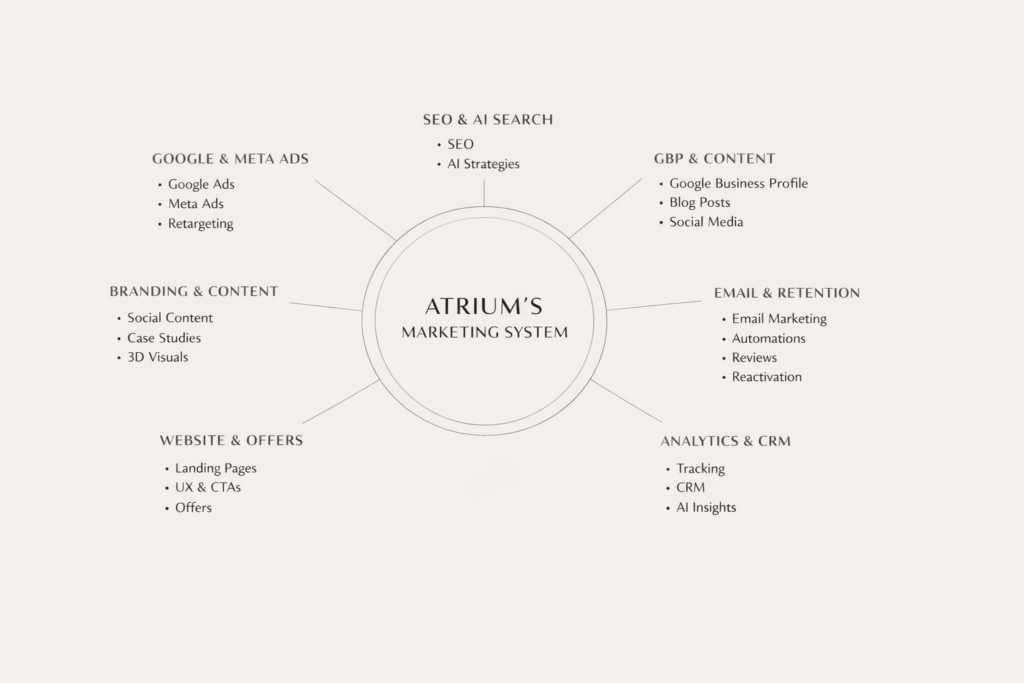
A proper system includes:

1. Demand Capture

Structured Google Ads campaigns targeting profitable services.

2. Demand Creation

Meta campaigns building visibility and trust before competitors appear.

3. Conversion Optimization

Landing pages designed to turn clicks into booked jobs.

4. Retention Systems

Email reminders, seasonal campaigns, and customer reactivation.

5. Authority Positioning

Content, visuals, and branding that reduce price shopping.

You can see how structured marketing impacts results in our Case Study for a Chimney Business


Why Hiring an Internal Marketing Team Often Fails

Many growing companies consider hiring:

A marketing manager
A social media person
An ads specialist

But quickly discover the reality:

Salary
Benefits
Training
Software
Management time

And still no full strategy.

One person rarely covers ads, branding, analytics, automation, and strategy effectively.


Your In-House Marketing Department, Without the Overhead

This is where our model is different.

ATRIUM operates as your in-house, out-of-house marketing department.

We integrate with your business like a team member.

We:

✔ Build strategy
✔ Manage advertising
✔ Implement systems
✔ Track performance
✔ Optimize continuously

You focus on operations and service delivery.

We handle marketing execution.

No payroll expansion.
No internal management burden.
No fragmented vendors.

Just one aligned team.


The Goal Is Not More Ads

The goal is stability.

When marketing works correctly:

You know where leads come from.
Slow season becomes predictable.
Revenue stops feeling reactive.

Ads become part of an engine, not emergency spending.


Final Thought

If you’re deciding between Google Ads and Meta Ads, you’re asking the right question.

But the better question is:

Do you have a marketing system working behind them?

Because platforms change.

A strong system keeps producing results regardless.

And that’s exactly what we build.

slow season marketing strategy for home service companies

Slow Season Marketing Strategy for Home Service Companies

Every year it happens.

Calls slow down.
The calendar starts opening up.
You look at payroll and start wondering where next month’s jobs will come from.

For many owners, the first reaction is simple:

Increase the ad budget.

But a proper slow season marketing strategy for home service companies is not about spending more money on ads.

It’s about building a system that keeps leads coming in even when demand drops.


Why Most Home Service Companies Struggle During Slow Season

The real issue during slow season is not traffic.

It’s structure.

Many home service companies depend on:

• Referrals
• Google Ads
• Reviews
• Busy season momentum

This works when demand is high.

But when slow season arrives, there is no pipeline, no follow-up system, and no predictable lead flow.

Ads become a temporary fix instead of a long-term strategy.


What a Slow Season Marketing Strategy Actually Means

A strong slow season marketing strategy for home service companies focuses on inbound demand instead of panic spending.

Inbound leads happen when customers find you naturally because your marketing system is working together.

That includes:

• A fully optimized Google Business Profile
• Service pages built for search visibility
• Educational website content
• Ongoing customer communication
• Strong online authority

Inbound marketing creates stability.

Once built, it keeps working even when you are focused on operations.


Demand Generation Without Relying Only on Ads

Ads are important, but they should support your strategy, not replace it.

A structured approach includes:

• Service-specific Google Ads campaigns
• Retargeting previous visitors
• Regional service pages
• Weekly Google Business Profile updates

👉 Example: Businesses improving visibility through proper GBP optimization often see consistent discovery traffic (see Google’s official GBP guidance: https://support.google.com/business).

This creates demand instead of chasing it.


Conversion Optimization: Where Most Revenue Is Lost

Getting clicks is only half the job.

When customers land on your website, they should immediately see:

• Clear service offers
• Trust indicators
• Financing or package options
• Proof of real projects

If every company looks the same online, customers compare price.

When positioning improves, customers compare value instead.

You can see how structured positioning impacts results in our
Flue Tech marketing case study


Retention Is the Real Slow Season Fix

The strongest slow season marketing strategy focuses on existing customers.

Instead of relying only on new leads, successful companies build:

• Maintenance programs
• Seasonal reminders
• Reactivation campaigns
• Review generation systems

Selling to past customers costs almost nothing compared to acquiring new ones.

If your database exists but isn’t being used, revenue is being left on the table.


Authority Positioning for Luxury Home Service Companies

Luxury service providers should not compete like commodity contractors.

Authority is built through:

• Educational content
• Before-and-after visuals
• Real project documentation
• Consistent messaging

When trust increases, price objections decrease.

This is why branding and visualization also play a role in marketing performance.

See how authority positioning supports large projects in this church capital campaign case study


The Slow Season Plan That Works

When slow season begins, we focus on:

• Reactivating past customers
• Promoting preventive services
• Booking future work early
• Increasing average ticket value
• Strengthening visibility before peak demand

Instead of reacting to slow months, the business becomes predictable.


What This Means for Business Owners

You should not have to:

• Wonder where leads come from
• Guess if ads are working
• Manage marketing tools
• Write campaigns yourself
• Track performance manually

Your role is operations.

Our role is marketing execution.

At ATRIUM, we operate as an extension of your team by designing, building, and managing the complete marketing system.


The Real Shift

Most companies buy revenue month by month.

High-performing operators build marketing assets.

A complete slow season marketing strategy for home service companies turns marketing from stressful into controlled growth.


If Slow Season Is Stressing You Out

Before increasing your ad budget again, ask:

Do I have a retention system?
Is my Google presence optimized?
Are my offers structured clearly?
Do customers see authority or just pricing?

If not, that’s where strategy starts.

And that’s exactly what we build.

What Most Chimney and Fire Safety Companies Get Wrong About Their Marketing

What Most Chimney and Fire Safety Companies Get Wrong About Their Marketing

February 13th 2026

Most chimney and fire safety companies treat February like a sales event instead of a trust-building opportunity. They increase ad spend during National Chimney Safety Week without first ensuring their messaging, offer structure, and follow-up systems can actually convert skeptical homeowners. The result is wasted budget on clicks that don’t become customers.

Why This Problem Exists Now

February is the industry’s designated awareness month. Trade associations promote it. Suppliers mention it. So most companies assume they should “do something” with their marketing during this window.

But three realities collide:

Ad costs spike. When multiple local competitors increase their Google Ads and Facebook budgets simultaneously, cost-per-click rises. You’re bidding against each other for the same search terms and the same audience. Platforms charge more because demand is higher.

Homeowners are comparison shopping. February promotions train buyers to wait for discounts. They’re not looking for the most qualified company. They’re looking for the best deal. This attracts price-sensitive leads who are harder to close and less profitable to serve.

Trust still matters more than urgency. Chimney and fire safety services involve real risk. Homeowners need to believe you know what you’re doing, that you’ll show up when scheduled, and that you won’t upsell unnecessary work. A February promotion doesn’t build that belief. It just makes you one of several companies offering a discount.

ATRIUM works with chimney and fire safety companies year-round. The pattern is consistent: businesses that treat February as a visibility boost without changing their underlying marketing infrastructure see temporary spikes in inquiries but no meaningful improvement in revenue or profit.

What Most Businesses Misunderstand

The assumption is simple: more awareness equals more customers.

So companies increase their budget, run promotions, and expect results. When leads don’t convert at the rate they hoped, they assume the problem is volume. They think they need even more traffic.

But volume isn’t the issue.

The issue is that most chimney and fire safety marketing looks identical. Same stock photos of fireplaces. Same language about safety and certification. Same discount-driven offers. When a homeowner sees three or four companies saying nearly the same thing, they default to price.

This isn’t the homeowner’s fault. It’s a differentiation problem.

Another common misunderstanding: assuming that being busy means marketing is working. February might generate calls. Your calendar might fill up. But if those jobs are lower-margin, require more follow-up, or come from customers who don’t refer others, you’re not building a sustainable system. You’re just staying busy.

ATRIUM sees this repeatedly across service and construction businesses. Activity gets confused with progress. Marketing spend increases, but profit per customer stays flat or declines.

What Actually Works at a Strategic Level

Effective marketing for chimney and fire safety companies isn’t about timing or promotions. It’s about clarity and positioning.

Clarity means knowing exactly who you serve best. Not all homeowners are the same. Some want the cheapest option. Some want the most experienced company. Some care about responsiveness. Some prioritize long-term relationships. If your marketing tries to appeal to everyone, it persuades no one.

The companies that grow profitably are the ones that define their ideal customer clearly and then build messaging, pricing, and service delivery around that profile. This makes every marketing dollar more efficient because you’re not paying to attract people you don’t actually want to work with.

Positioning means explaining why you’re different in a way that matters to the buyer. This isn’t about being “the best” or “certified” or “experienced.” Every company claims that. Positioning is about identifying the specific problem your ideal customer faces and demonstrating that you understand it better than anyone else.

For example: a company that specializes in historic homes doesn’t just “do chimney work.” They solve a specific problem—preserving original materials while meeting modern safety standards. That’s a position. It’s narrow, but it’s clear. And it attracts the right kind of customer.

When your positioning is sharp, you spend less time educating leads about why they should choose you. They already understand. The sale becomes easier and faster.

What to Focus on Instead

If you’re spending money on marketing right now—whether it’s February or any other month—these are the priorities that determine whether that spend works:

Budget clarity. Know exactly how much you’re spending, where it’s going, and what you’re getting back. Not in terms of clicks or impressions, but in terms of actual customers and actual profit. If you can’t connect a marketing dollar to a result, you can’t make intelligent decisions about where to invest more or pull back.

Lead quality over lead volume. A hundred inquiries from people shopping on price is worse than twenty inquiries from people who value expertise. Structure your messaging and your offers to filter out the wrong leads before they waste your time. This means being willing to say no to certain types of work and certain types of customers.

Messaging that builds trust, not urgency. Homeowners hire chimney and fire safety companies because they’re worried about safety, frustrated by unreliable contractors, or confused about what actually needs to be done. Your messaging should address those concerns directly. Explain your process. Show how you handle common problems. Demonstrate competence in a way that feels specific, not generic.

Systems that turn leads into customers. Marketing gets people to raise their hand. What happens next determines whether they become paying customers. If your follow-up is slow, inconsistent, or handled differently by different people, you’re losing deals. The businesses that grow are the ones that treat follow-up as a system, not a task.

ATRIUM works with businesses that have these fundamentals in place. When the infrastructure is sound, increasing marketing spend produces predictable results. When it’s not, more budget just creates more waste.

The Real Opportunity in February

February isn’t useless. But it’s not a standalone strategy.

The real opportunity is using heightened awareness to position yourself as the company that does things differently. While competitors are discounting, you can focus on education. While they’re chasing volume, you can focus on qualifying the right leads.

This requires confidence in your pricing and clarity about who you serve. It also requires patience. You won’t “win” February by generating the most calls. You’ll win by attracting the customers who become long-term relationships and referral sources.

That’s a harder sell internally. It’s easier to justify marketing spend when the phone rings constantly. But sustainable growth comes from profitable customers, not just busy schedules.

FAQ

Why does my cost per lead go up during February?

Because multiple chimney and fire safety companies increase their ad budgets at the same time, competition for the same keywords and audience segments drives up auction prices on platforms like Google and Facebook. Higher demand equals higher cost.

Should I stop running promotions during National Chimney Safety Week?

Not necessarily. But promotions should serve a strategic purpose—like attracting a specific type of customer or filling a particular service gap. If you’re discounting just because everyone else is, you’re training customers to wait for deals and competing primarily on price.

How do I differentiate when every company offers the same services?

Differentiation isn’t about what you do. It’s about who you do it for, how you do it, and what specific problem you solve better than anyone else. Narrow your focus to a particular customer type or service category and build your messaging around their specific concerns.

What’s the most common reason chimney and fire safety marketing doesn’t work?

Poor follow-up. Most businesses generate enough leads. The breakdown happens in how quickly and consistently they respond, how they qualify interest, and how they move people from inquiry to scheduled appointment. Marketing creates opportunity. Systems convert it.

Is it worth spending more during February or should I spread budget evenly across the year?

It depends on whether your infrastructure—messaging, positioning, follow-up, service delivery—is ready to handle increased volume profitably. If those fundamentals aren’t in place, spreading budget evenly and focusing on sustainable systems will produce better long-term results than capitalizing on a short seasonal spike.

The Atrium Review

Listen to our podcast

Atrium Review

Post recientes

  • Titulo

    Subtitulo

  • Titulo

    Subtitulo

  • Titulo

    Subtitulo

             
           Let’s Talk Strategy

If you’re spending on marketing but not seeing the results you expected, the problem probably isn’t your budget. It’s clarity.

ATRIUM helps chimney, fire safety, and specialty construction companies build marketing systems that produce predictable, profitable growth. If you’d like a straight conversation about what’s working, what’s not, and where to focus next, reach out. No pressure. Just clarity.

Schedule a free consultation

Schedule a free


Diego romero

Leads paid media and performance strategy at ATRIUM. He specializes in structured Google Ads systems for luxury home service and construction businesses. Diego holds certifications in Google Ads (Search & Display), Google Analytics, Meta Media Buying, HubSpot Inbound Sales, and Hootsuite Academy

    The Atrium Insider
    Get one email a month with design tips, free templates, and behind-the-scenes stories from the studio.

    Join the Newsletter


    Últimos articulos

    • Titulo articulo

      Subtitulo

      Quis aute iure reprehenderit in voluptate velit esse cillum dolore eu fugiat nulla pariatur. Ex…

    • Titulo articulo

      Subtitulo

      Quis aute iure reprehenderit in voluptate velit esse cillum dolore eu fugiat nulla pariatur. Ex…

    • Titulo articulo

      Subtitulo

      Quis aute iure reprehenderit in voluptate velit esse cillum dolore eu fugiat nulla pariatur. Ex…

    Continue reading

    Business owner feeling overwhelmed by digital marketing options like AI tools, social media, and online advertising.

    Are Google Ads Still Worth It in the Age of AI?

    Why Local Businesses Still Win With Google Search Advertising

    Artificial intelligence is changing how people search online. Tools like ChatGPT, Google’s AI Overviews, and voice assistants are transforming the way users discover information.

    Some business owners are asking an important question:

    If AI is answering questions directly, do we still need Google Ads?

    The short answer is yes, more than ever.

    AI is changing marketing, but it is not replacing search advertising. In fact, Google Ads remain one of the most powerful ways for local businesses to capture customers who are ready to take action.

    For service-based businesses like real estate agencies, restaurants, contractors, and local professionals, search advertising continues to be one of the highest-intent lead generation channels available.

    Let’s look at why.


    Google Still Dominates Search

    Despite the growth of AI tools, Google remains the primary place where people search for businesses, services, and solutions.

    According to StatCounter, Google maintains around 90% of the global search engine market share.

    Source

    That means when someone searches:

    • “roof repair near me”
    • “best realtor in Brooklyn”
    • “Italian restaurant downtown”
    • “contractor for home remodel”

    they are overwhelmingly likely to use Google Search first.

    For local businesses, being visible in those searches is critical.


    Google Ads Capture High-Intent Customers

    One of the biggest advantages of Google Ads is intent.

    Unlike social media advertising, where users are browsing casually, Google Ads appear when someone is actively searching for a solution.

    For example:

    Low intent search behavior
    Browsing Instagram for inspiration

    High intent search behavior
    “Emergency plumber near me”

    Those high-intent searches are extremely valuable.

    Research shows that businesses make an average of $2 in revenue for every $1 spent on Google Ads.

    Source:
    Google Economic Impact Report

    Google Ads also allow businesses to appear immediately at the top of search results, even above organic listings.

    For local service providers, this means capturing customers exactly when they are ready to call or book a service.


    AI Is Changing Search, But Not Replacing It

    Google has introduced AI-powered search features called AI Overviews, which generate summaries directly within search results.

    Source:
    Google AI Overview documentation

    These summaries appear mainly on informational searches, such as:

    • “How does escrow work?”
    • “Best neighborhoods in Brooklyn”
    • “What is the average cost of roof repair?”

    But when users are ready to act, they typically perform transactional searches, such as:

    • “Brooklyn real estate agent”
    • “roof repair company near me”
    • “restaurant reservations New Jersey”

    These searches still trigger:

    • Google Ads
    • Google Maps results
    • business listings

    Google has also confirmed that advertising will be integrated into AI search experiences, meaning ads will continue to be part of the search ecosystem.

    Source: Google Ads Help Center

    Rather than replacing ads, AI is being used to optimize targeting, bidding, and campaign performance.


    Digital Advertising Continues to Grow

    Another strong indicator that ads are not disappearing is the continued growth of the advertising market.

    Global advertising revenue is projected to exceed $1 trillion annually, with digital advertising accounting for the largest share.

    Source: Reuters

    Google alone generates over $200 billion per year in advertising revenue, demonstrating the continued demand for search advertising.

    Source: Alphabet Annual Reports

    If search advertising were becoming obsolete, companies would not continue investing billions into it.


    Why Google Ads Are Essential for Local Businesses

    For local service providers, Google Ads offer a unique advantage: visibility at the moment of need.

    When someone searches for a service nearby, Google prioritizes results that help users take immediate action.

    This is especially valuable for businesses such as:

    Real Estate Agencies

    Buyers and sellers often search for local agents when they are ready to make a move.

    Restaurants

    People frequently search for nearby dining options while actively planning where to eat.

    Contractors and Construction Companies

    Homeowners often search Google when they need repairs, renovations, or quotes.

    Professional Services

    Lawyers, consultants, financial advisors, and medical providers rely heavily on search visibility.

    In each of these cases, Google Ads can place a business directly in front of customers exactly when they need the service.


    How AI, SEO, and Social Media Fit Into the Strategy

    While Google Ads should be the core of the strategy, modern marketing works best when several channels support each other.

    Google Ads

    Capture high-intent customers searching for services.

    SEO (Search Engine Optimization)

    Build long-term visibility through optimized website content and local search rankings.

    Google Business Profile

    Improve visibility in Google Maps and local searches.

    Meta Advertising

    Generate brand awareness and discovery through Instagram and Facebook.

    AI Tools

    Use AI to analyze market trends, generate content, and improve campaign performance.

    Instead of replacing advertising, AI helps optimize these systems and make them more efficient.


    A Practical Marketing Framework for Local Services

    A modern local marketing strategy often follows this structure:

    1. Google Ads capture high-intent leads actively searching for services.
    2. SEO and website content build long-term visibility and authority.
    3. Google Business Profile optimization improves local discovery through Maps.
    4. Meta advertising introduces the brand to new audiences.
    5. AI tools improve research, content creation, and data analysis.

    This layered strategy helps businesses reach customers at every stage of the buying journey.


    How Atrium Helps Local Businesses Grow

    At Atrium, we help service-based businesses build marketing systems designed to generate consistent leads.

    Our approach focuses on combining high-intent advertising with long-term visibility strategies.

    We support businesses with:

    Google Ads Campaign Management

    Strategic keyword targeting, campaign optimization, and performance tracking designed to generate qualified leads.

    Website Design and Conversion Optimization

    Websites built to turn search traffic into inquiries, calls, and bookings.

    SEO and Content Strategy

    Search-optimized content that improves rankings and helps businesses appear in both traditional and AI-driven search results.

    Google Business Profile Optimization

    Improving visibility in Google Maps and local search results.

    Meta Advertising

    Social media campaigns designed to build awareness and support search traffic.

    AI-Assisted Marketing Systems

    Using AI tools to improve content creation, data analysis, and campaign efficiency.

    Our goal is to create marketing systems that generate consistent growth for local businesses.


    Frequently Asked Questions

    Are Google Ads still effective in 2026?

    Yes. Google remains the dominant search engine, handling the vast majority of online searches worldwide. Google Ads allow businesses to appear at the top of search results when customers are actively looking for services.


    Do AI search results replace advertising?

    No. AI search features provide informational summaries, but transactional searches still display ads, local listings, and business results.

    Source


    Are Google Ads better than social media ads?

    They serve different purposes. Google Ads capture high-intent searches, while social media ads are better for brand awareness and discovery.

    The most effective strategy usually combines both.


    What types of businesses benefit most from Google Ads?

    Local service providers often benefit the most, including:


    • contractors and construction companies
    • real estate agencies
    • restaurants and hospitality businesses
    • healthcare providers
    • home services and repair companies
    • professional services


    How much should a local business invest in Google Ads?

    Budgets vary by industry and market, but even modest campaigns can generate meaningful leads when properly optimized.

    The key factor is targeting the right keywords and local audiences.


    Final Thoughts

    Artificial intelligence is changing the digital landscape, but it is not replacing search advertising.

    If anything, AI is helping platforms like Google become more sophisticated in how they deliver ads and connect businesses with customers.

    For local service providers, Google Ads remain one of the most powerful tools for generating qualified leads and growing a business.

    Businesses that combine search advertising with strong websites, SEO, local optimization, and AI-assisted marketing strategies will be best positioned for the future.


    Ready to turn search traffic into real leads?

    If you’d like help building a strategy tailored to your business, Atrium can help design a marketing system that combines Google Ads, SEO, local search optimization, and AI-powered marketing tools to generate consistent growth.

    Schedule a Consultation

    How AI Search Is Changing the Way Clients Find You (and How to Stay Visible)

    Search is evolving, and AI tools are now recommending brands, services, and studios directly. If your visibility feels flat, the issue isn’t demand, it’s how people are discovering. This guide shares how ATRIUM helps design-driven businesses stay visible and trusted across AI platforms, globally.On this page

    AI Discovery: The New Way Clients Find You

    AI platforms like ChatGPT, Perplexity, and Google’s AI experiences are acting as digital advisors. They synthesize, compare, and recommend, not just list links. These systems prefer content that is specific, verifiable, and consistent. Generic statements like “quality service” or “innovative solutions” are ignored, clear proof wins.

    For design-led businesses, the opportunity is simple, speak clearly about outcomes, demonstrate expertise with first-hand evidence, and make your brand easy to recognize across the web.

    ATRIUM’s Five-Pillar Framework

    1) Brand Clarity

    AI systems identify entities, not just keywords. Define your brand with consistent language, visuals, and positioning everywhere. If you specialize in high-fidelity 3D visualization or brand systems for architects, say it the same way across your site, profiles, and features. Consistency helps AI understand who you are and when to recommend you.

    2) Service Specificity

    Specific services outperform generic labels. Replace broad terms with clear, outcome-focused descriptions, for example, “Cinematic architectural renderings built to secure faster approvals and investor confidence,” or “360° project experiences for pre-sales and leasing campaigns.” Create proprietary names where relevant, such as “Signature Visualization” or “Architect’s Preview Render,” and use them consistently.

    3) First-Party Proof

    Publish insights only you can provide, real project breakdowns, timelines, measurable results, process documentation, and lessons learned. Case studies and data points signal authority. AI systems favor sources with original expertise over summaries that anyone can produce.

    4) Third-Party Credibility

    What others say about you matters. Earn mentions through features, directories, partner pages, and associations. Encourage clients to share public testimonials and project credits. A distributed footprint helps AI connect references back to your brand and increases the likelihood of being recommended.

    5) Integration Over Isolation

    Treat visibility as an ecosystem. Brand clarity supports authority, authority attracts mentions, mentions build trust, trust drives recommendations. Start with your strongest pillar, shore up the weakest, and maintain a consistent standard across all touchpoints.

    Related ATRIUM pages:

    Why Acting Now Matters

    Most teams still optimize only for traditional search, yet clients are already researching with AI every day. Early movers set the standard, secure references across platforms, and become the default recommendation when prospects ask for the best partner in their category.

    If you want AI to recommend your brand for architectural visualization, branding, or web design, build clear signals, share first-hand expertise, and earn credible mentions. The advantage compounds over time.

    Get a tailored AI-visibility plan

    In one consult, we’ll audit your current footprint, identify quick wins, and map a practical plan for international reach.

    Schedule a call with ATRIUM

    FAQs

    How is AI search different from traditional SEO?

    Traditional SEO targets ranked lists, AI search synthesizes and recommends. Clear brand definitions, first-party proof, and third-party credibility play a bigger role than ever.

    What type of content does AI trust?

    Original insights, project data, timelines, measurable outcomes, and expertise from credible sources. Summaries without evidence are less effective.

    How fast can results show?

    Timelines vary by footprint. Brands with consistent language, live case studies, and existing mentions see quicker movement. The earlier you standardize signals, the better.

    Can ATRIUM help with international reach?

    Yes. ATRIUM aligns your services, case studies, and website to match AI discovery patterns, then supports authority with targeted features and consistent brand language across markets. From ATRIUM, your boutique creative partner for 3D visualization, branding, and web design.